
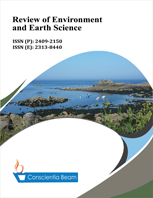
Review of Environment and Earth Sciences (REES) is an international, peer-reviewed, multidisciplinary journal dedicated to advancing scientific knowledge on the interactions among the Earth system, environmental processes, ecosystems, and human societies. The journal provides a platform for the publication of original research articles, review papers, short communications, and case studies that contribute to the understanding, sustainable management, and protection of natural and environmental resources.
The journal welcomes high-quality contributions that address fundamental and applied aspects of environmental and earth sciences, with particular emphasis on interdisciplinary approaches that bridge geological, hydrological, biological, chemical, geographical, and engineering perspectives.
1. Hydrogeology and Water Resources
Research related to groundwater occurrence, movement, recharge, storage, and management, including aquifer characterization, groundwater modeling, water security, watershed management, and sustainable utilization of water resources.
2. Hydrochemistry and Water Quality
Studies focusing on the chemical characteristics of surface water and groundwater, water pollution, contaminant transport, aquatic geochemistry, water treatment technologies, and assessment of water quality for environmental and human health.
3. Geochemistry
Research addressing the chemical composition and processes of the Earth, including elemental cycling, isotope geochemistry, environmental geochemistry, mineral-water interactions, geochemical modeling, and contaminant behavior in natural systems.
4. Geophysics and Earth System Processes
Investigations utilizing geophysical methods to explore subsurface structures, geological hazards, tectonic processes, environmental monitoring, resource exploration, and Earth system dynamics.
5. Engineering Geology and Geohazards
Studies concerning geological factors affecting engineering projects, infrastructure development, slope stability, land subsidence, seismic hazards, risk assessment, and geotechnical investigations.
6. Remediation Science and Environmental Restoration
Research on innovative approaches for the remediation of contaminated soil, water, and sediments, including bioremediation, phytoremediation, ecological restoration, pollution control, and environmental recovery strategies.
7. Natural Resources Management
Contributions addressing the sustainable exploration, conservation, and management of natural resources, including land, water, minerals, forests, and energy resources, with consideration of environmental and socio-economic impacts.
8. Environmental Climatology and Biota
Studies examining climate-environment interactions, climate variability and change, ecosystem responses, biodiversity conservation, ecological resilience, and the impacts of environmental change on living organisms.
9. Environmental Geography and Spatial Analysis
Research focusing on environmental landscapes, land-use and land-cover change, spatial modeling, Geographic Information Systems (GIS), remote sensing applications, environmental planning, and human-environment interactions.
10. Soil Science and Land Degradation
Investigations into soil formation, classification, fertility, contamination, conservation, erosion, carbon sequestration, sustainable land management, and soil-ecosystem relationships.
11. Geomicrobiology and Environmental Biotechnology
Research exploring interactions between microorganisms and geological materials, microbial geochemistry, biogeochemical cycling, environmental biotechnology, biomineralization, and microbial applications in environmental remediation.
12. Interdisciplinary Environmental and Earth Sciences
The journal particularly encourages interdisciplinary studies that integrate multiple scientific disciplines to address contemporary environmental challenges, climate change adaptation, sustainability, ecosystem services, environmental policy, and the achievement of global sustainable development goals.
Review of Environment and Earth Sciences welcomes contributions from researchers, practitioners, policymakers, and professionals worldwide that advance scientific understanding and provide practical solutions for environmental stewardship and sustainable development.